It reads the file whole
A thousand-page production is split across many passes rather than sliced down to a sample, and a chronology is built under Labor Code §4062.3 from all of it.
record-digest.service.ts · RecordDigestService
The demand names a patient, a date range and a party you have never corresponded with. Somewhere in the practice is every record that answers it, along with a corrected report that supersedes an earlier one, two copies of the same imaging study filed by different senders, and one document that should not go out at all. The work is not finding the files. It is producing them in a form that will still hold up when someone asks, eleven months later, what exactly you sent.
ChironAI OM assembles that production from the chart you already hold — numbered, indexed, attested — and keeps the record of it afterwards. The parts of the chart that are untidy are declared on the face of the packet rather than smoothed over, because those are the parts that get asked about.
Records arrive from everywhere — the employer, the claims administrator, prior treaters, imaging centres, the applicant’s attorney. Before you can answer a demand you have to know what you hold.
A disclosure is not a folder of files. It is a response to a particular demand, from a particular party, on a particular date — and the packet has to carry that on its face.
Real charts are untidy. The same report is filed twice. A corrected version sits beside the original. A scan will not open. A packet that quietly tidies that away is the one that falls apart under examination, because the discrepancy is exactly what opposing counsel asks about.
The question that arrives months later is rarely "what is in the chart". It is "what did you send, and when did you send it".
Front matter
Cover sheet
Labelled, not numbered
The patient, the case or the whole chart, the requesting party, the purpose, the scope applied, how many documents were produced and how many were withheld, who produced it and when.
Front matter
Manifest
Labelled, not numbered
One row per document considered for production — included or not. Date, title, and then either the Bates range or the word WITHHELD followed by the reason. Superseded rows are flagged, and a byte-identical repeat is flagged as a duplicate of the row that first carried it.
The production
Produced pages
PREFIX-000001 onward, continuous
Every produced page carries a Bates stamp, and the range is recorded against the document it belongs to. A superseded record is preceded by a banner so it cannot be mistaken for the current version. A format that cannot be rendered gets a placeholder page rather than a gap in the sequence.
Attestation
Certificate of completeness
Labelled, not numbered
The attestation, the produced and withheld counts, the Bates range the packet spans, the scope applied, the requesting party and the purpose. Delivered as a ZIP instead of a merged PDF, the same three sheets travel with it, so an archive on its own is still self-describing.
The cover, the manifest and the certificate are deliberately outside the Bates sequence. A citation in a deposition refers to a produced document, not to the producing party’s own paperwork, so the practice’s front matter never consumes a number that a range in the manifest would then have to account for.
Disclosure runs both ways. The production that leaves the practice is one problem; the one that arrives is the harder one. A med-legal case can turn up as a thousand pages or three thousand, assembled by someone with no interest in making it easy to read, with the decisive four lines somewhere in the middle of it.
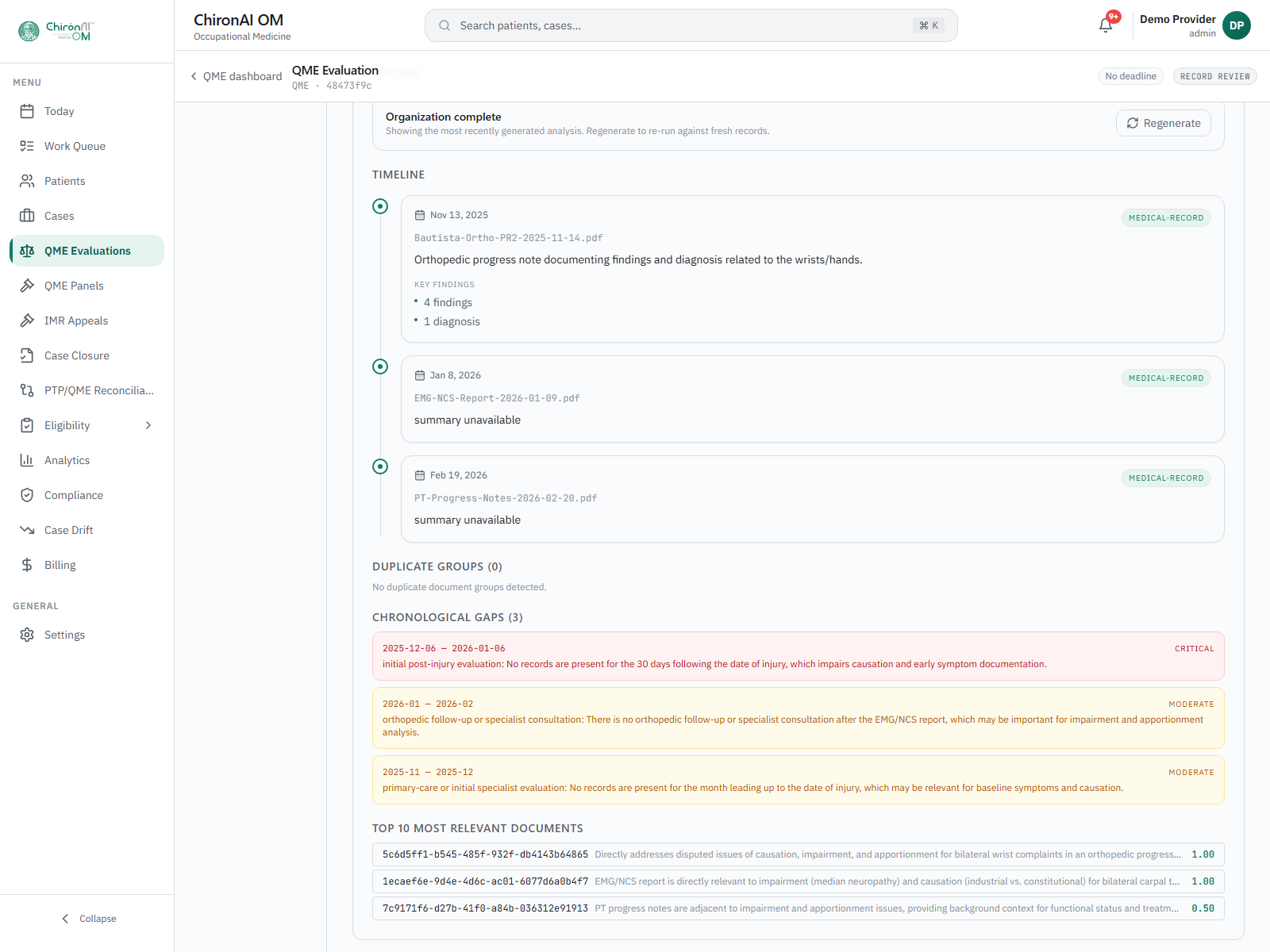
The record digest reads that file and returns a chronology. Eight of its behaviours are worth naming, and all eight are constraints rather than features — they describe what the system is structurally unable to do.
A thousand-page production is split across many passes rather than sliced down to a sample, and a chronology is built under Labor Code §4062.3 from all of it.
record-digest.service.ts · RecordDigestService
A record that was properly served is admissible. A record stricken, prohibited under 8 CCR §35(e), or sitting under an unresolved objection is excluded. A record never seen in any served package is quarantined — unknown admissibility fails closed to not-yet-admissible, and stays out of the chronology until a person decides otherwise.
admissibility-segregation.ts · segregateRecords
Duplicate source documents are matched on content and folded together, so a report that arrived from the carrier, the prior treater and the attorney is not counted as three events on a timeline.
record-digest-chronology.ts · dedupeSourceDocs
Every chronology entry has to cite one of the documents actually fed to the reasoning. An entry citing anything else is discarded rather than included and flagged.
record-digest-chronology.ts · buildProvenancedEntries
Extracted dates are validated as real calendar dates. An undated event is bucketed as undated rather than given a plausible one — a wrong date moves causation, apportionment and every statutory clock that runs from it.
record-digest-chronology.ts · isValidIsoDate
A conflict between sources is surfaced as an explicit dispute citing both, not resolved in favour of the more recent or the more confident. The disagreement between records is frequently the fact that matters.
record-digest-chronology.ts · reconcileConflicts
Where a source exceeded the synthesis budget, the digest carries a warning naming the document, how much of it was read, and the fact that the remainder was never read and its findings are missing.
record-digest.service.ts · truncationWarnings
Once the chronology exists, an adversarial pass goes back over every entry and attempts to break it against the source it cites. Entries it cannot support are marked unsupported or contradicted and surfaced in the warnings — never quietly deleted, because the physician decides what comes out.
record-digest-verification.ts · planVerification
Those anchors are function names in the product, not a description of it. Why a constraint written in code is a different kind of promise from a constraint written in a prompt is the subject of how we prevent fabrication, which is the page to read next if the previous paragraph sounded like a claim rather than a mechanism.
Disclosure and production is a single group in the ChironAI OM inventory. The rest of it — the chart, the case lifecycle, causation, utilization review, the DWC forms and their clocks, and the revenue cycle — is enumerated on the capabilities page, and what shipped on which date is in the release notes.
We will assemble the production against it on a synthetic chart, show you the manifest it generates, and void it in front of you so you can see what survives. If the packet does not look like something you would be content to hand to opposing counsel, that is the useful outcome of the meeting.
Book a demo →Bring one month of EORs — you keep the findings either way.
Tell us the workflow you want to see and who needs to be in the room. A member of our clinical and engineering team replies within two business days to arrange it — a real person, not a sequence.
Talk to our team →What happens after you send it
Prefer to talk now? +1 (949) 200-8668, or email hello@mindhyve.ai.