Critical — contraindicated
Combination is contraindicated. Hard stop in the prescribing flow. Requires explicit override with clinical justification.
Decision support. ChironAI surfaces drug-interaction context for the prescribing clinician. The clinician decides whether to write, modify, or hold the prescription. ChironAI does not make a regulatory clearance claim; see Disclosures.
ChironAI does not treat drug interactions as a checkbox warning. Before anything is drafted, the Chiron copilot runs a drug_interactions() check against the working medication list — so each prescription arrives with the full medication context (indication, mechanism, contraindication, dose-adjustment guidance) and each interaction surfaces with the pharmacology mechanism, severity tier, and the canonical source that warrants the call. The copilot proposes; it asks for your approval before it acts.
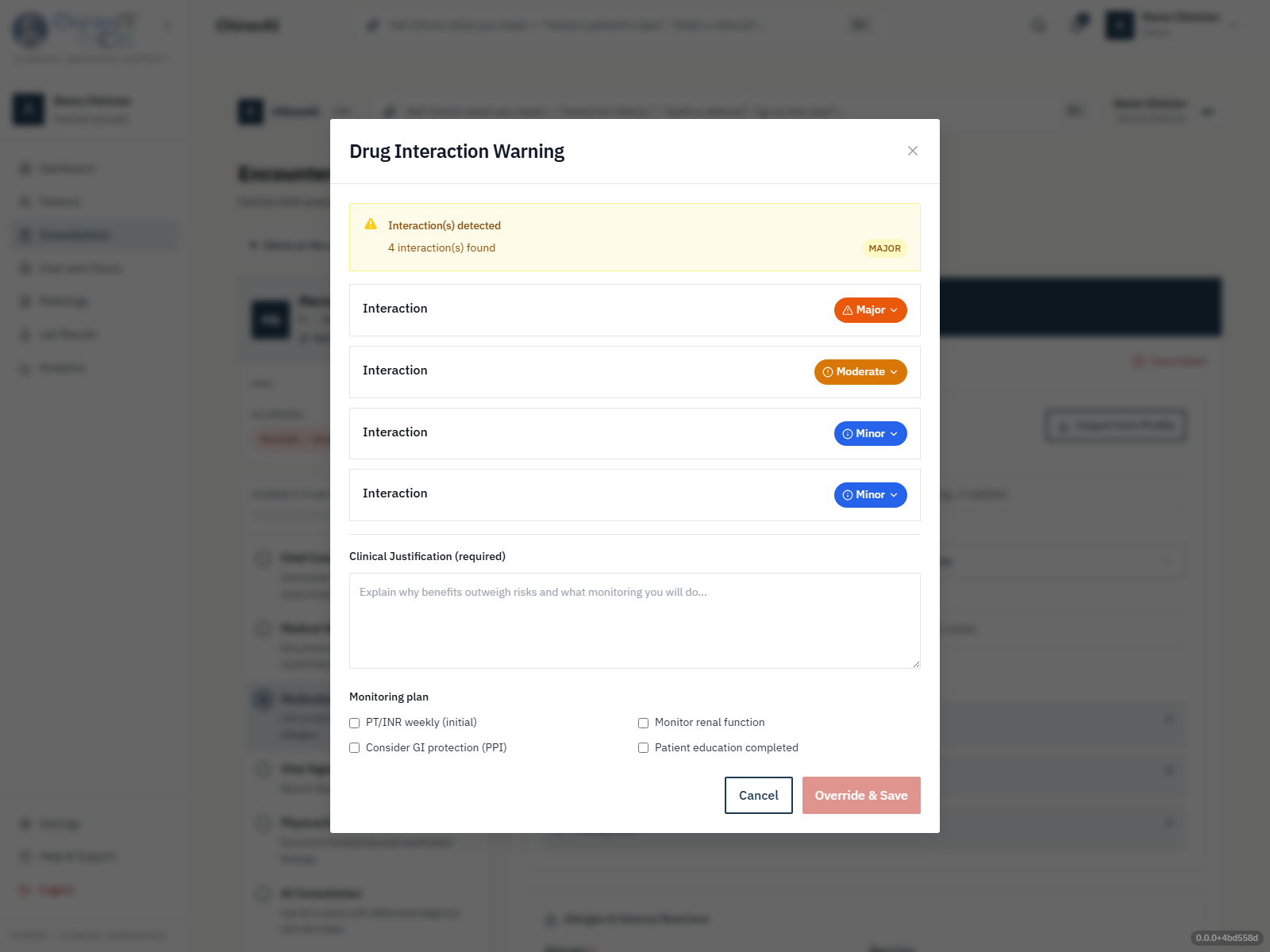
Combination is contraindicated. Hard stop in the prescribing flow. Requires explicit override with clinical justification.
Significant interaction risk. Monitoring required. Recommendation surfaced inline with the prescription.
Caution. Surfaced as informational alert. Clinician can proceed but should consider alternatives or counsel the patient.
Informational. Surfaced for awareness; rarely changes the prescription. Suppressible per clinician preference.
Must review before final
Decision-support output. Clinician review and attestation required before this content is signed into the chart.
new: TMP-SMX · against: warfarin, lisinopril, metformin
One major interaction returned; two cleared. Surfaced before the script is drafted.
Interaction
Mechanism
TMP-SMX inhibits warfarin metabolism via CYP2C9, displaces warfarin from protein binding, and may potentiate hypoprothrombinemia. INR can rise within 3–5 days of initiation, with bleeding risk.
Recommendation
Avoid combination if alternative antibiotic available. If unavoidable, reduce warfarin dose by 25–50% and monitor INR within 3–5 days.
Awaiting your approval
When a prescription would trigger a step-therapy requirement or prior auth under common payer formularies, ChironAI surfaces the flag inline — before the clinician signs the script and the patient learns about it at the pharmacy.
The flag includes the typical step-therapy alternative or the prior-auth criterion that the prescription would need to satisfy. The clinician can adjust the prescription, request the prior auth, or proceed with explicit acknowledgement.
Tell us the workflow you want to see and who needs to be in the room. A member of our clinical and engineering team replies within two business days to arrange it — a real person, not a sequence.
Talk to our team →What happens after you send it
Prefer to talk now? +1 (949) 200-8668, or email hello@mindhyve.ai.