Pass 01
Structure
Macroscopic anatomy scan and orientation. Confirms technical adequacy, identifies anatomical variants, and frames the second-look.
Decision support. ChironAI does not produce a finalized read. Every report is reviewed and signed by a board-certified radiologist before it goes to chart. ChironAI does not make a regulatory clearance claim; see Disclosures.
ChironAI radiology is a Chiron-driven diagnostic read that surfaces what a fast pass might miss. Chiron works the study as a structured five-pass review — with explicit cognitive-bias counter-measures, framework selection across roughly thirty-five named frameworks and nine RADS systems, Red-Alert discipline for time-critical findings, and source-cited findings — and hands the radiologist an attestable ten-section draft report, with the reasoning streaming even as the study is being read. The radiologist remains the primary reader, evaluates the surfaced findings, drafts the impression of record, and signs the report before it goes to chart.
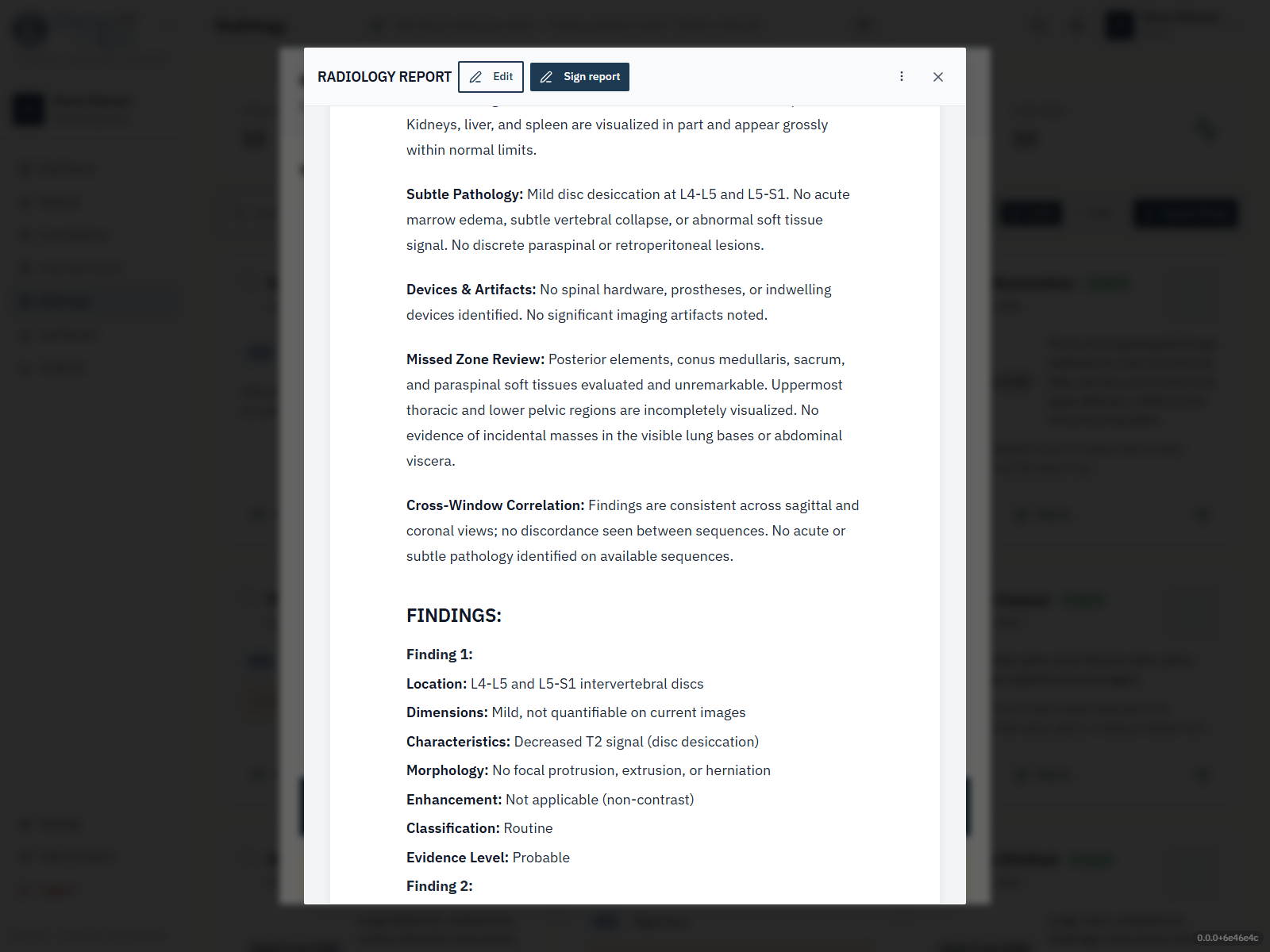
Macroscopic anatomy scan and orientation. Confirms technical adequacy, identifies anatomical variants, and frames the second-look.
Subtle-pathology and early-disease pattern recognition. The dense pass — surfaces candidate findings the radiologist evaluates and confirms.
Devices, iatrogenic findings, and imaging-artifact differentiation. Distinguishes "patient" from "tube," "calcification" from "compression artifact."
Systematic scan of regions commonly overlooked in fast reads — lung apices on chest X-ray, occipital horns on head CT, retrocardiac on chest CT.
Cross-window and sequence correlation across the full study. Connects findings across phases and series before the radiologist drafts the impression.
The five passes carry explicit cognitive-bias counter-measures — the read is prompted to work against satisfaction of search, anchoring, and premature closure rather than assume them away. The passes resolve into a ten-section structured report, which the radiologist evaluates and attests.
Each mockup below shows what the system surfaces as decision-support reference. The radiologist’s reviewed and signed impression is the chart-of-record; ChironAI does not produce the report.
Must review before final
Decision-support output. Clinician review and attestation required before this content is signed into the chart.
Red-Alert findings
Time-critical. Surface to the supervising clinician for action.
Draft report — for radiologist attestation
Spiral oblique fracture of the right tibial diaphysis at the mid-shaft, with mild lateral displacement and angulation. Associated comminuted fragment laterally. Fibular shaft intact.
Cortical break at the distal tibial metaphysis with a lucent fracture line; adjacent soft-tissue swelling. Checking for a second fracture and for physeal involvement before
Negative findings cited explicitly
Must review before final
Decision-support output. Clinician review and attestation required before this content is signed into the chart.
Draft report — for radiologist attestation
2.3 cm hypervascular lesion in hepatic segment VII demonstrating arterial-phase hyper-enhancement, portal-venous washout, and capsule appearance. Findings raise concern for HCC; differential includes hypervascular metastasis and hepatic adenoma. Clinical correlation and tumor-marker workup recommended.
Negative findings cited explicitly
Around thirty-five named frameworks ship in code, including nine RADS systems. Chiron selects the modality-appropriate framework for the study; the selection below is a representative sample of what it speaks.
Breast imaging
Liver lesions
Prostate MRI
Lung cancer screening
Thyroid nodules
Thyroid (ACR variant)
Tumor response in solid tumors
PET-based tumor response
Stroke imaging
Long-bone fractures
Renal cystic lesions
CT colonography
Time-critical findings deserve their own surface. ChironAI’s architecture routes them through a separate notification path so they are not buried inside routine reference content the radiologist scans through.
Red-Alert findings are architecturally separated from routine outputs. They surface in a distinct visual treatment, route through a separate notification path, and require explicit acknowledgement before the radiologist closes the read. The must-review-before-final gate still applies on top.
Tell us the workflow you want to see and who needs to be in the room. A member of our clinical and engineering team replies within two business days to arrange it — a real person, not a sequence.
Talk to our team →What happens after you send it
Prefer to talk now? +1 (949) 200-8668, or email hello@mindhyve.ai.