ChironAI™ CDS — Clinical Decision Support
Edition 01CDS · Clinical Decision Support

A Digital Employee who runs the encounter — and hands you the chart to sign.

ChironAI™ CDS is the Agentic Healthcare Operating System for hospitals, clinics, and health-sciences institutions. Chiron — the clinical Digital Employee — drives the encounter: it gathers the record, reads the labs, checks safety, reasons the differential, and drafts assessment, plan, and orders for your signature. Every step is visible, the reasoning streams as it happens, and nothing enters the chart until a physician attests it. Powered by Eve-Healthcare™ F5/reasoner. Generally available since September 24, 2025.

The workspaceCommand-first · agentic

You give the command. Chiron runs the plan.

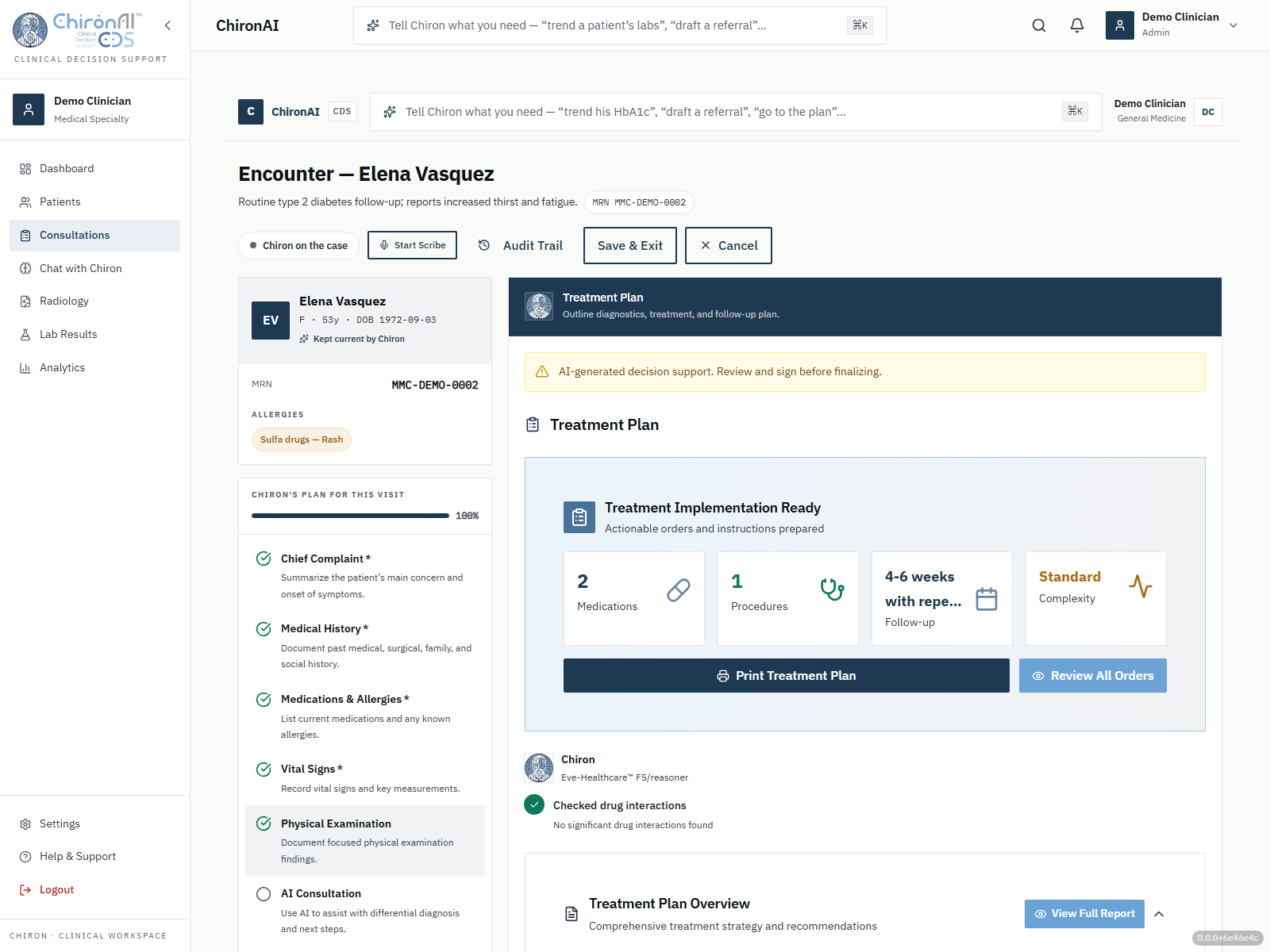
The encounter is not a form to fill. You state the intent; Chiron builds and runs a live plan, calling the tools it needs and narrating its reasoning as it goes. You watch the work happen — the chart being read, the labs being checked against critical-value cutoffs, safety being screened — and the differential is reasoned in front of you, not returned from a spinner. Reasoning streams live across eleven clinical touchpoints, the copilot chat, and even while a study is being read. Every artifact lands as a draft for your attestation.

ChironAI™ CDSEncounter · agentic run

Must review before final

Decision-support output. Clinician review and attestation required before this content is signed into the chart.

Work up Ms. Okafor — 62 F, fatigue and exertional dyspnea, three weeks.

Chiron’s plan

  1. 01

    Gather the record

    read_record()

    done
  2. 02

    Read the labs

    search_labs()

    done
  3. 03

    Check safety

    drug_interactions()

    done
  4. 04

    Reason the differential

    streaming
  5. 05

    Draft assessment, plan, and orders for attestation

    queued
Reasoning · streaming

Anemia and early heart failure both fit the fatigue and exertional dyspnea. The low hemoglobin on this panel and a normal BNP shift weight toward a work-up for anemia first, but cardiac cannot be excluded on this data — recommending a BNP repeat and iron studies before

Draft — ChironPhysician attestsSigned to chart
Chiron drives the plan; the physician attests every output before it enters the chart.Illustrative — representative of product UI. Synthetic case data; not from any real patient.

Visible, named tool-calls

Chiron does not reason in a black box. It works through seventeen tenant-scoped, audited, approval-gated tools — and shows you each call it makes, to audit in the moment or after. Four of them anchor the encounter:

read_record()

Pulls the chart into working context — problem list, history, medications, prior notes — so the encounter reasons over the whole patient, not a single field.

search_labs()

Reads the panel and matches it against the pattern library and twenty-two critical-value cutoffs. The values are extracted ground-truth — read from the report, never generated.

drug_interactions()

Checks the working medication list before anything is drafted — four-tier severity with the mechanism and the pharmacology source that warrants each call.

find_patient()

Lets the Chiron copilot locate the patient you mean by name or identifier, then confirms with you before it acts on the chart.

Safety by architectureNot a policy — a construction

The safety is built into the architecture, not promised in a policy.

The hard part of clinical AI is not producing an answer — it is producing one a physician can trust and a regulator can inspect. ChironAI puts the guarantees below into the code path, where they hold whether or not anyone is watching. This is the part sophisticated clinical buyers check first.

Lab numbers cannot be hallucinated

Lab values are extracted by Azure Document Intelligence directly from the source report — a deterministic layer, separate from the reasoning engine. Chiron may label and interpret a value; it cannot invent a digit.

A tamper-evident, append-only audit trail

Every clinical action is written to an append-only audit log. A database trigger blocks edits and deletes — even by the record’s owner — so the trail is tamper-evident by construction, not by policy.

PHI encrypted and de-identified

Sensitive fields are protected with AES-256 encryption, and PHI is de-identified in the reasoning pipeline. The reasoning layer works on the minimum it needs.

The disclosure is server-authoritative

The AB 3030 generative-AI disclosure and the must-review-before-final gate are enforced on the server, not the browser. A client cannot dismiss its way past the disclosure.

A deterministic clinical-alert engine

Alongside the reasoning, a deterministic engine of twenty-five rules fires clinical alerts on fixed criteria — predictable, testable, and independent of the model’s judgment.

Architectural tenant isolation

Every row carries a tenant boundary, and Row-Level Security policies are defined at the database layer. No customer data flows to other customers, to cross-customer analytics, or to any training pipeline.

Beyond the single encounter

What Chiron keeps running between visits.

A curated dashboard cockpit

Chiron curates the day into a working cockpit — who needs attention, what is unsigned, which reads are waiting — instead of a static list you triage yourself.

A maintained patient snapshot

For each patient, Chiron keeps a living snapshot — the priors, current results, and open questions that matter now — assembled from the record and kept current as the encounter moves.

A copilot that asks before it acts

The Chiron copilot knows your patients and can act across the chart through seventeen tenant-scoped, audited tools — but it surfaces its plan and asks for your approval first. Bounded agency, by design.

CapabilitiesTwenty cells, seven specialty deep-dives

The capabilities Chiron reaches for, in one screen.

Reasoning

Differential diagnosis

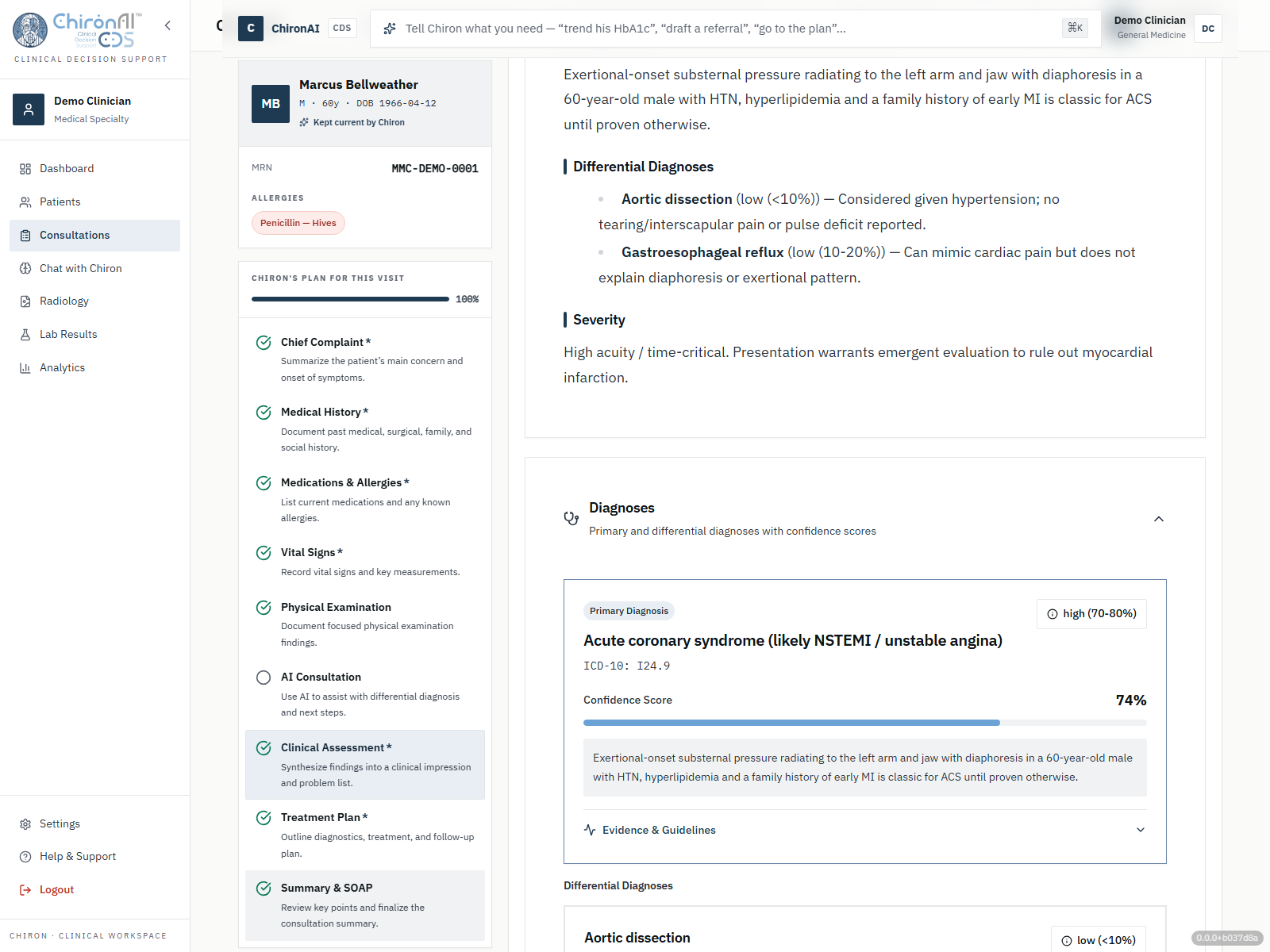
Causal reasoning over presenting features with Bayesian confidence calibration and an auditable trace through the underlying evidence base.

Reasoning

Symptom intelligence

From the chief complaint, Chiron ranks the highest-yield symptoms to screen for next — the differentials each separates, where it is captured, and the red flags. The system proposes what to ask; the clinician decides.

Reasoning

Pre-existing condition intelligence

Prior conditions ranked for this specific patient — clinical impact, risk category, and the screening questions that confirm or exclude each — so the prior that changes everything is surfaced at intake, not missed.

Reasoning

Evidence synthesis

Live synthesis of canonical clinical guidelines and peer-reviewed literature, with explicit guideline-anchor citations and confidence calibration.

Reasoning

Risk stratification

Wells, GRACE, MELD, CHA₂DS₂-VASc, TIMI, and other canonical scoring frameworks with the reasoning that justifies each score.

Imaging

Multi-pass radiology

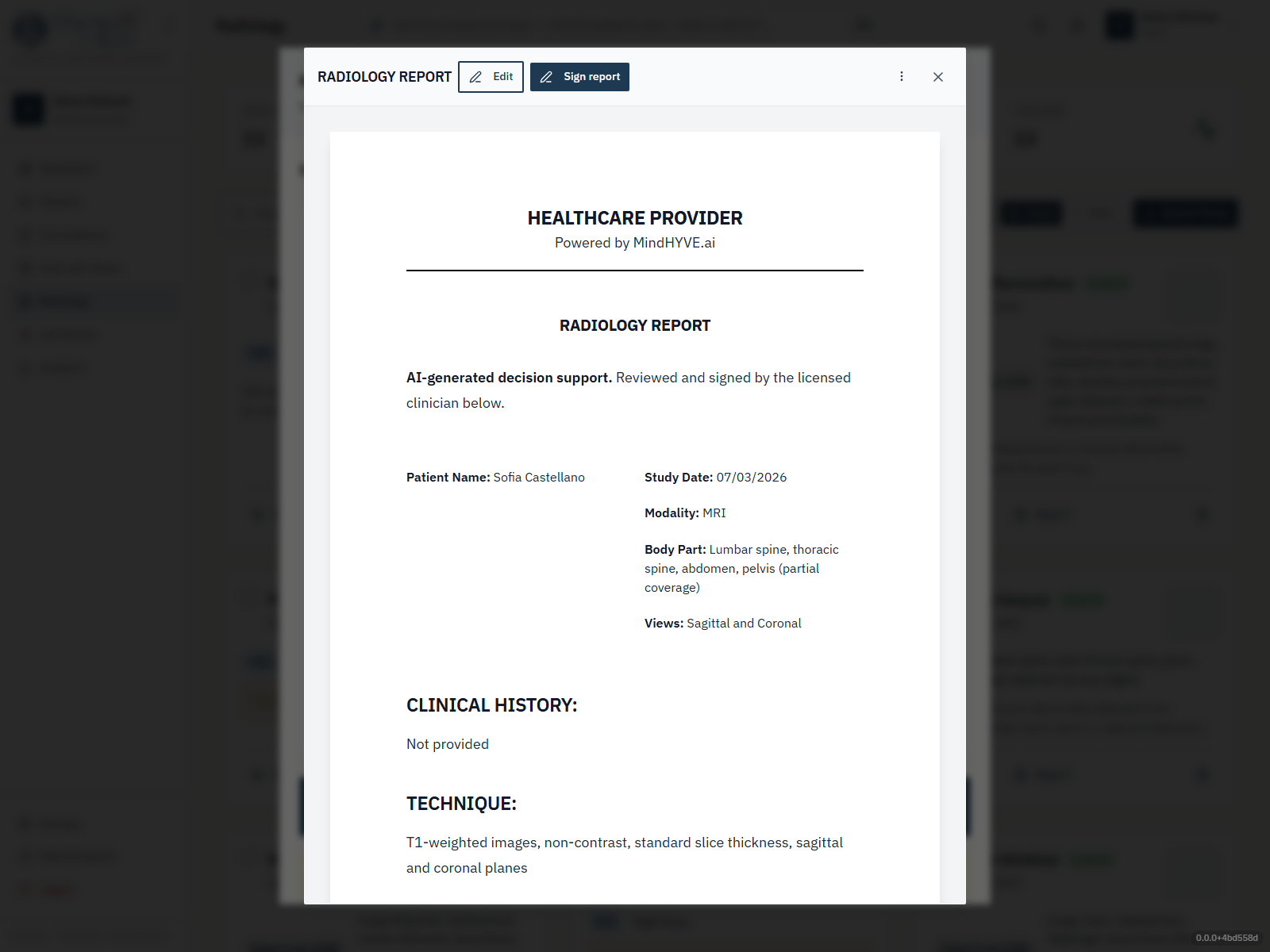
Five-pass diagnostic read with explicit cognitive-bias counter-measures and a ten-section report. Around thirty-five named frameworks across nine RADS systems (BI-RADS, LI-RADS, PI-RADS, and more). Red-Alert discipline.

Diagnostics

Lab pattern recognition

Thirteen canonical lab patterns and twenty-two critical-value cutoffs. Values extracted ground-truth from the source report, never generated. Reference-range adjustment for demographic context.

Documentation

SOAP source-grounding

Every statement in the generated SOAP note traceable to its underlying source field, source value, and source date in the chart. The audit chain stamps the trace.

Documentation

Multi-language output

Twelve locales out of the box (English, Spanish, French, German, Hindi, Mandarin, Arabic, Tagalog, Vietnamese, Korean, Portuguese, Russian). RTL support.

Prescribing

Drug interaction reasoning

Four-tier severity (critical, major, moderate, minor) with mechanism disclosure. Step therapy and prior auth flags. Evidence anchoring to the canonical pharmacology source.

Prescribing

Medication schemas

Full medication context: indication, mechanism, contraindication, drug-drug and drug-disease interaction, dose-adjustment guidance. RxNorm-anchored.

Engagement

Pre-visit patient interview

Structured pre-visit interview by AI Digital Employee — history, ROS, risk flags surfaced before the clinician walks in. Patient input feeds the consultation context.

Engagement

Patient education

Multi-language patient education at six reading levels (kindergarten through professional). The system meets the patient where they read.

Workflow

Document versioning

Every signed document gets an immutable SHA-256 hash at signature time. Amendments are recorded as new versions; the original signed version stays verifiable.

Compliance

Must-review-before-final

Architectural AB 489 gate. Every AI artifact carries the non-dismissible review banner. Every PDF export carries the disclosure in the footer. Persistent invariant.

Compliance

Tamper-evident audit chain

HMAC + previous-hash audit log on every clinical action. Immutability enforced at the database layer. Tamper-evident verifiable end to end.

Reasoning

Confidence calibration

Six-tier qualitative scale plus quantitative Bayesian percentages. “Cannot exclude” as a first-class state when the data is insufficient.

Workflow

Visible tool-calling

Seventeen tenant-scoped, audited, approval-gated tools. Chiron shows the call it is about to make, and the copilot asks before it acts on the chart.

Reasoning

Streaming reasoning

Reasoning streams live across eleven clinical touchpoints, the copilot chat, and even while a study is being read — you watch the thinking, not a spinner.

Documentation

Ambient scribe

The ambient scribe turns the captured encounter into a structured chart draft — source-grounded and staged for the physician to attest.

A named architectureSection 03

Multi-pass radiology.

ChironAI's radiology workload runs as a five-pass structured read — examining macroscopic structure, subtle pathology, artifacts and devices, commonly missed zones, and cross-window correlation — with explicit cognitive-bias counter-measures built into the process and around thirty-five named frameworks across nine RADS systems on tap. Each pass surfaces a distinct class of findings with its own evidence trace, and the read resolves into a ten-section report the radiologist attests.

  1. Pass 01Structure

    Macroscopic and structural review of the imaged anatomy.

  2. Pass 02Pathology

    Subtle pathology and early-disease pattern recognition.

  3. Pass 03Artifacts

    Devices, iatrogenic findings, and imaging-artifact differentiation.

  4. Pass 04Missed Zones

    Systematic scan of regions commonly overlooked in routine reads.

  5. Pass 05Correlation

    Cross-window and sequence correlation across the full study.

Strategic partnerships

Three regions. Three buyer contexts. One reasoning architecture.

United States

California Northstate University

Strategic Collaboration Framework, March 2026. The first U.S. health-sciences university to integrate a reasoning-first agentic AI platform into its academic curriculum. ChironAI collaboration around pharmacogenomics applications within the College of Pharmacy, alongside an integrated education-to-clinical intelligence pipeline tied to CNU's teaching hospital under construction.

Source: PR Newswire · March 11, 2026

East Africa

Kadisco General Hospital, Ethiopia

Strategic MoU, September 2025. ChironAI for clinical decision support at one of Ethiopia's leading private healthcare institutions. Kadisco handles 50,000+ patient visits and 15,000 emergency cases annually, in a country with fewer than 1.5 physicians per 10,000 people. Three pillars: clinical innovation, hospital operations, workforce capacity-building.

Source: PR Newswire · October 7, 2025

South Asia

KPSIAJ — Fatimiyah Hospital, Karachi

Strategic MOU, December 2025. ChironAI in non-clinical readiness evaluation at Fatimiyah Hospital — workflow review, de-identified case simulation, Pakistan-context localization, and definition of readiness criteria (safety, performance, governance). Phased adoption with AI literacy training first.

Source: PR Newswire · December 22, 2025

Compliance posture

HIPAA-aligned controls, audit-grade reasoning traces, and physician-attested outputs at every step. Compliance is engineered into the reasoning substrate, not bolted on at the application layer.

ChironAI™ CDS runs on Eve-Grid™ — MindHYVE's proprietary Azure-native cloud architecture, custom-engineered for compound-AI workloads with the latency and reliability properties regulated healthcare requires.

Your patient’s data stays in your tenant. Tenant isolation is architectural — every row carries a tenant boundary and Row-Level Security policies are defined at the database layer; customer data does not flow to other customers, to MindHYVE for cross-customer analytics, or to any model training pipeline. The supporting claim follows: no customer data is used for training, because no customer data ever reaches the training pipeline. Our reasoning capability is built on Eve-Genesis (Clinical Edition) — proprietary, synthetic, and anchored to the canonical guidelines and clinical taxonomies clinicians use every day. Read how →

Every output traceable to its underlying reasoning. Every clinical recommendation is structured for clinician review — the physician decides, the AI reasons.

Architecture

Powered by Eve-Healthcare™ F5/reasoner.

The Fusion of five cooperating reasoning models, augmented by a dedicated vision model. Microsoft Phi-3 as classifier. Microsoft Phi-4 LoRA-fine-tuned on Eve-Genesis (Clinical Edition) as the clinical reasoner. Three frontier models as frontier slots, one of them a 10M-token long-context model for longitudinal context.

The architecture absorbs frontier progress rather than being threatened by it. When a new frontier model lands, we swap the slot. The proprietary classifier and the Eve-Genesis-tuned reasoner stay stable.

Read the architecture →
A note to the reader

Talk to our clinical team.

For institutional deployment conversations, demo requests, and partnership inquiries.

Start a conversation →