Decision support. Every determination on this page is structured for physician review before it reaches a payer, an attorney, or the chart. ChironAI OM reasons and ranks; the licensed physician signs. ChironAI does not make a regulatory clearance claim; see Disclosures.

ChironAI OMClinical intelligence

Right now, the physician is the integration layer.

Somebody in your practice is reading a two-thousand-page file while holding, at the same time, the twelve elements Labor Code §4628 requires in the report, which of those records are even admissible under §4062.3, whether the apportionment survives §4663 and the Escobedo substantial-evidence bar, what the adopted MTUS guideline said on the date of service rather than today, and four statutory clocks that all started on different days. Nobody holds all of that. Miss one §4628 element and the report is inadmissible with the medical-legal fee forfeited, which is not a discipline problem and never was.

ChironAI™ OM holds it instead. Not as a summary, and not as a second opinion — 88+ customer-facing AI capabilities, each one anchored to a named function in the product and re-derived from the live codebase on 2026-09-21. The physician stops being the index and goes back to being the decider, which is the only role they were ever licensed for.

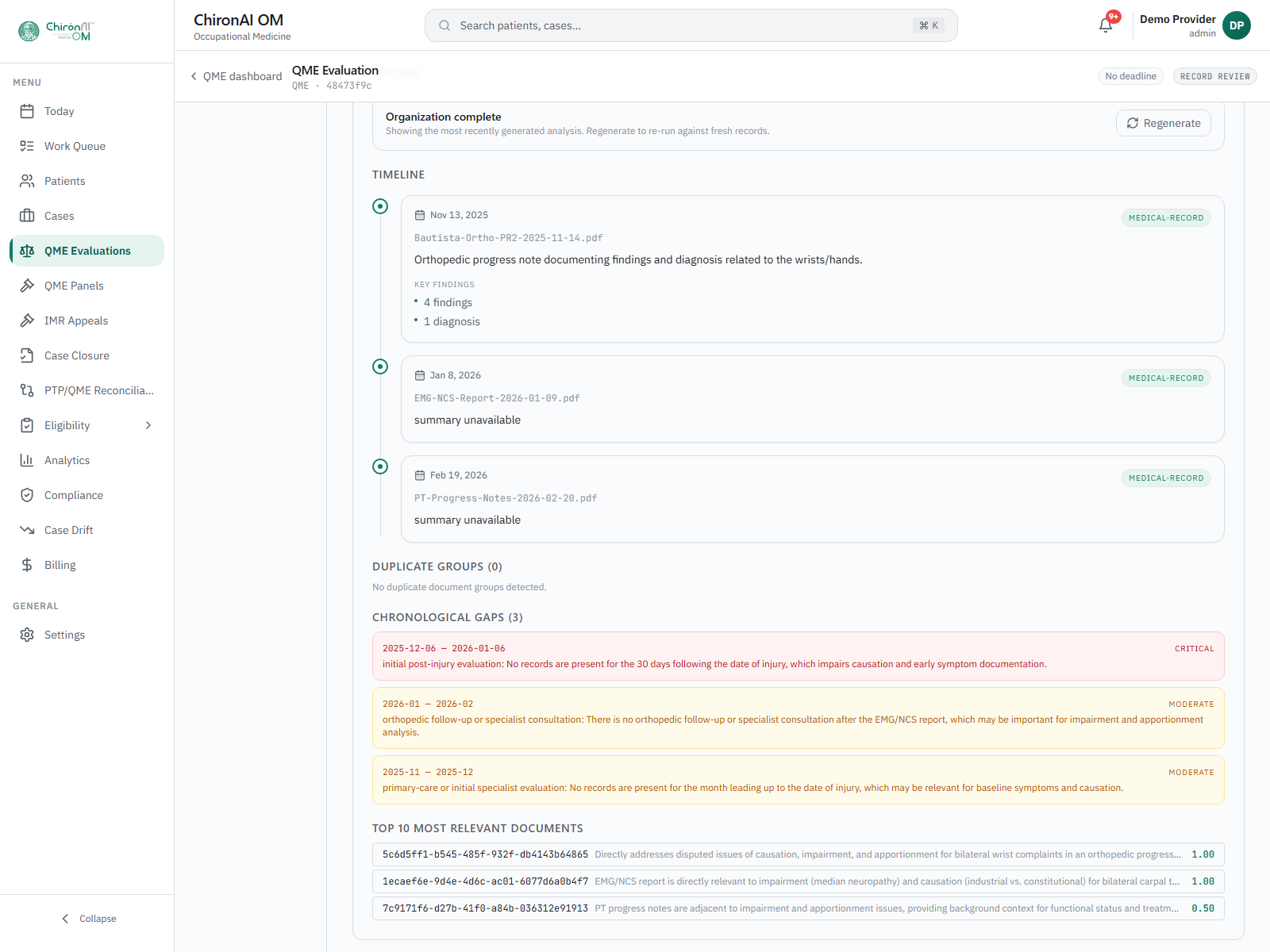
Record organisation inside a ChironAI OM QME evaluation: a dated timeline of source documents with their filenames and key-finding counts, a duplicate-groups panel reading zero, three chronological gaps ranked critical and moderate with the reason each one matters to causation and apportionment, and a ranked list of the most relevant documents in the file.
The gaps are the part a person loses. A thirty-day hole after the date of injury is flagged as critical here because of what it does to causation — not because the file is short. Synthetic data throughout — no screen on this site shows a real patient or a real practice.
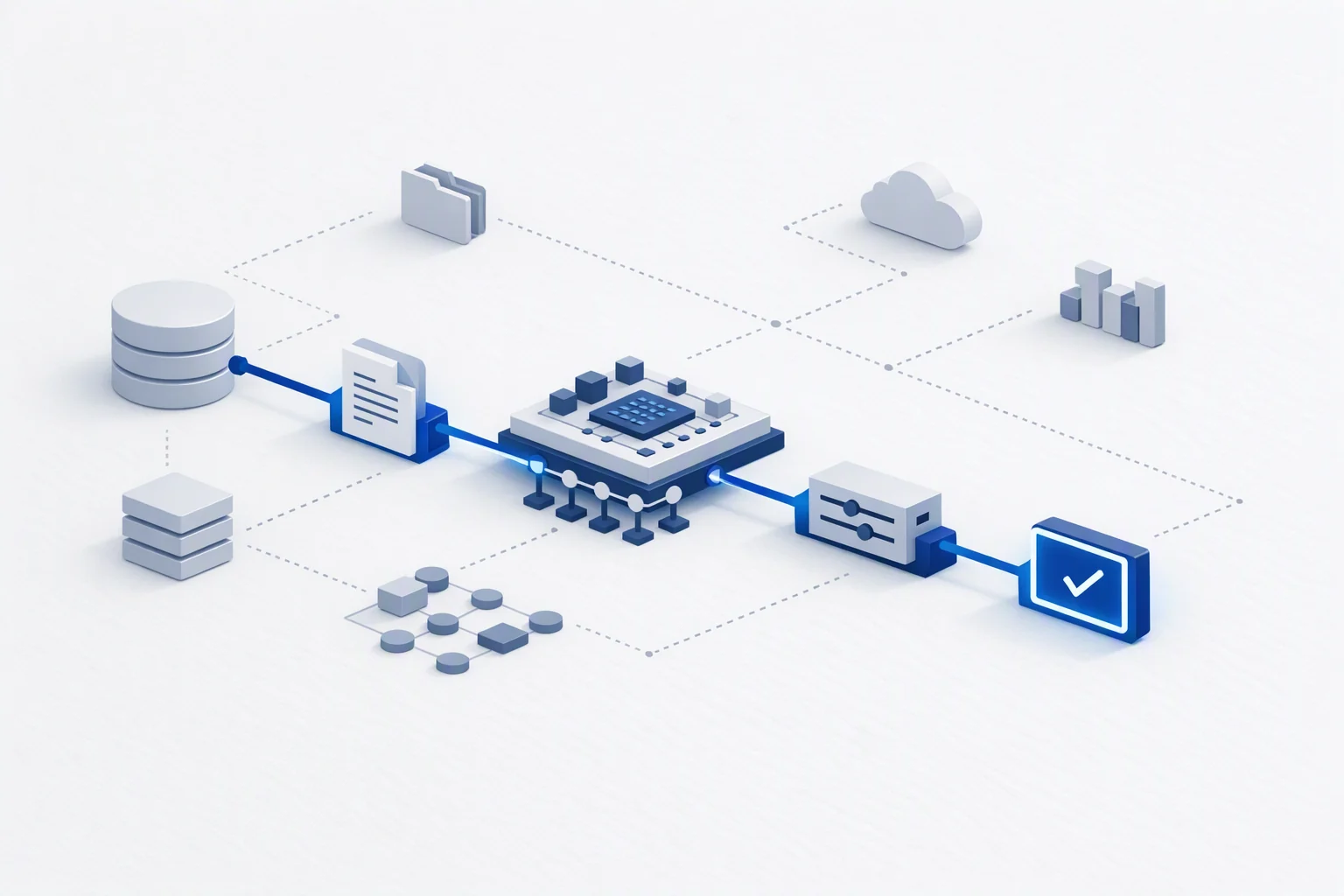
Isometric diagram: a lit path threaded through a subset of nodes in a connected record network, ending at a conclusion element
What you are carrying

Six things a California occ-med physician holds at once, and where each one goes.

Labor Code §4628

The twelve elements a medical-legal report must contain, remembered section by section while writing it. A report that omits a required element is inadmissible and the medical-legal fee is forfeited under §4628(e).

Held by the system. The report is graded against the twelve-element checklist as it is written, and the admissibility items hard-gate finalisation rather than producing a warning somebody scrolls past.

compliance-check.ts · LABOR_CODE_4628_ELEMENTS

Labor Code §4062.3

Which of the records in the box may actually be considered, and whether anything in them is the product of a substantive ex-parte communication.

Held by the system. Records are segregated into admissible, quarantined and excluded before anything is read for content, and the §4062.3(g) taint is tracked rather than assumed away.

admissibility-segregation.ts · segregateRecords

Labor Code §4663 · §4664

How much of the impairment is industrial, what the prior award actually covered, and whether a §4664 offset survives the three-prong test.

Held by the system. A multi-factor apportionment analysis with the prior-award offset computed deterministically, and the legal authorities drawn from a fixed registry that rejects anything outside it.

apportionment.service.ts · class ApportionmentService

Escobedo

Whether the apportionment reasoning would be found to rest on substantial evidence, or would be picked apart as conclusory.

Held by the system. A legal-sufficiency pass runs over the apportionment finding against the Escobedo standard and the Brodie/Strait, Hikida and Almaraz/Guzman lines before the physician reads it.

justine.service.ts · VALID_AUTHORITY_KEYS

MTUS / ACOEM

What the adopted California guideline says about this body part — and which version of it was operative on the date of service, which is rarely the current one.

Held by the system. Every adopted guideline carries the Administrative Director order that adopted it and its version date, so retrieval is pinned to the text that governed the date of service.

mtus-provenance.ts · MTUS_PROVENANCE

Four clocks, four start dates

Thirty calendar days for the QME report from commencement, with extensions that must be requested at least five days out; the §4610 utilization-review window; §4603.2 and §4622 on the money. All counting from different events.

Held by the system. Each deadline is computed in calendar days in the clinic’s own time zone, from the event the statute names, and the extension request is refused when it arrives too late to be valid.

qme-deadline.service.ts · class QmeDeadlineService

None of that removes a judgement. It removes the bookkeeping that sits underneath the judgement and crowds it out — which is the part that gets dropped at five in the afternoon on the eleventh file of the day.

The Round Table

It convenes only the specialists a case actually needs.

A single reasoner answering a workers’-compensation question is one opinion with a confidence attached to it. The Round Table is a set of specialist Digital Employees opened against explicit conditions, so the case record shows not only what each one said, but why it was asked at all.

ChironClinical reasoning lead
Leads every case. The other seats are opened against Chiron’s finding, not instead of it.
IssacUtilization-review / IMR risk
Consulted on every case, without exception, for denial and appeal exposure.
JustineLegal-evidence framing
Opens when the case raises apportionment, or when the determination comes back mixed.
EliFinancial / OMFS exposure
Opens when the case carries a billing dispute, and stays shut when it does not.
TheoBias and fairness review
Opens when Chiron’s confidence is below 70 — or is not stated at all, because an unknown confidence is not a high one.

The seats are relayed rather than fanned out: one specialist’s reasoning streams at a time, so a physician watching the panel is reading one train of thought instead of five interleaved ones. A seat that fails is isolated and the determination proceeds with what came back, carrying the gap on its face rather than stalling the case or quietly filling it in.

ChironAI™ OMCausation analysis

Must review before final

Decision-support output. Clinician review and attestation required before this content is signed into the chart.

ChironMedical causation leadLead

AOE/COE - industrial. The mechanism (floor-level lift, 65 lb) is consistent with the L4-L5 disc herniation newly demonstrated on the 2025-11-12 MRI and absent on the only prior lumbar imaging. Documented prior low-back episodes were transient with full work capacity between them.

Seats convened

  • JustineLegal-evidence framingSeat opened

    Consulted because the case raises apportionment.

    Substantial-evidence standard met (Escobedo). Prior episodes were transient with full work capacity between - no basis for a §4664 prior-award offset. Apportionment to non-industrial cause is not supported on this record beyond documented degenerative change.

  • TheoBias and fairness reviewSeat opened

    Consulted because lead confidence is below the 70% review threshold.

    No bias indicators. The determination rests on objective imaging and mechanism of injury, not demographic priors. Conservative-approach check passed; recommend documenting the negative 90-day non-industrial history explicitly.

  • IssacUtilization-review / IMR riskSeat opened

    Consulted on every case.

    Denial / IMR-challenge probability low (~18%). Recommend attaching the MRI comparison and the negative non-industrial history to preempt a utilization-review challenge.

  • EliFinancial / OMFS exposureSeat not needed

    Consulted only when a billing dispute is present - not triggered here.

    Not consulted: no billing dispute on this case. (When present, Eli analyzes OMFS alignment and denial-cost exposure.)

Case WC-2026-04812 — Is the L4-L5 disc herniation arising out of and in the course of employment (AOE/COE), and how should it be apportioned?Illustrative — representative of product UI. Synthetic case data; not from any real patient.
Visible reasoning

Watch it work, and watch what it will not say.

While the Round Table runs, the physician sees which specialist is working, which guideline it retrieved and what it found, streamed as it happens. That is the glass-box half, and it is the easy half. The harder half is the outbound control on that same stream.

Every reasoning fragment leaves the server through one function, not through twelve different subsets of controls on twelve different screens. It collapses any foundation-model or vendor reference to the single engine label, rewrites phrasing that would imply clinical licensure under California AB 489, and withholds a fragment entirely when what the reasoner is narrating is its own output format rather than clinical analysis.

The private chain-of-thought each component uses to reach a finding is not part of that stream and is not retained. What survives to the record is the structured finding and the citations behind it.

Why one function and not twelve

There are twelve places in the product where a reasoning fragment reaches a clinician. They once applied overlapping but different sets of controls, and the surface with the fewest put raw output-format notes in front of a treating physician.

The fix was the union, applied at one choke point, rather than a wider pattern in any one control. We mention it because a vendor who will not tell you what leaked is not telling you much.

Ask the case

The question you would have to read four hundred pages to answer.

Retrieval runs over a semantic index of the case documents and over the guideline corpus, in plain language, with the in-product help searched alongside the record so “how do I file this” and “what does the file say” are the same box. A draft citation that matches no document actually indexed to the case is deleted before the answer is assembled.

ChironAI™ OMAsk the case

Question

Has the patient had any prior lumbar imaging before this injury?

Answer

The only prior lumbar imaging on file is a 2020 X-ray, and it did not show a disc herniation. (source: Radiology: X-ray, lumbar spine, 2020-06-14)

Source — Radiology. X-ray, lumbar spine 2020-06-14

The 2025-11-12 MRI newly demonstrates an L4-L5 disc herniation that is not present on that prior film. (source: Radiology: MRI, lumbar spine, 2025-11-12)

Source — Radiology. MRI, lumbar spine 2025-11-12
Citation-verification guardrail. A draft citation to a “2019 MRI” surfaced during retrieval but matched no document indexed to this case. It was deleted before the answer above was assembled.
Case WC-2026-04812Illustrative — representative of product UI. Synthetic case data; not from any real patient.
Before it goes out

Know the denial risk while you can still do something about it.

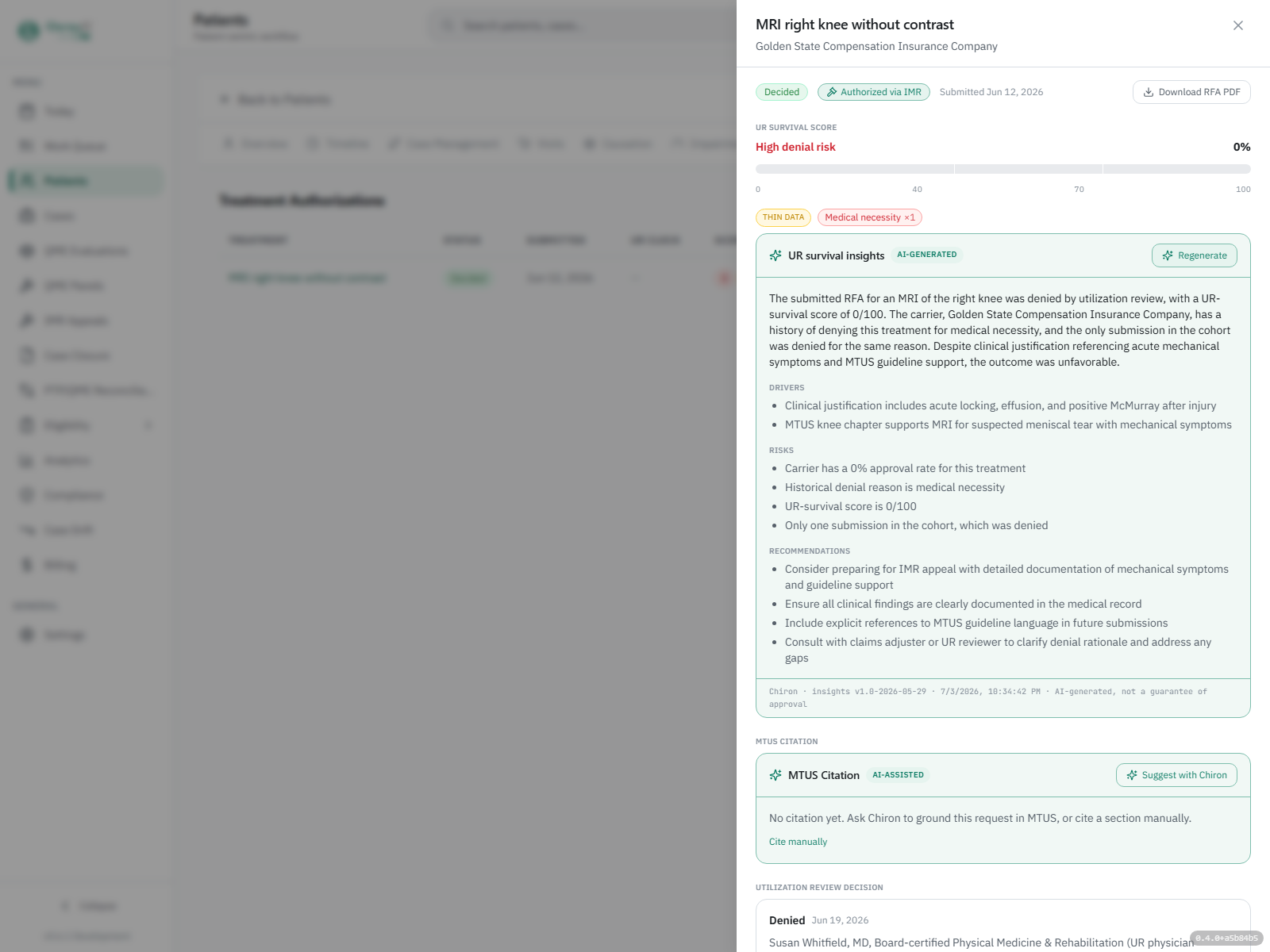
A request for authorization is scored for whether it will survive utilization review, the downstream Independent Medical Review exposure is estimated, and the evidence that would close the gap is named. A denied request is three weeks of treatment nobody delivered and nobody billed, decided by a reviewer who only ever sees the paper you sent.

A treatment-authorization panel in ChironAI OM for an MRI of the right knee. A UR survival score reads high denial risk at zero out of one hundred, with thin-data and medical-necessity flags. Below it an AI-generated UR survival insights block lists the drivers, the risks including the carrier's historical denial reason, and four recommendations, footed with a line reading AI-generated, not a guarantee of approval. An MTUS citation panel and the utilization-review decision follow.
The score is zero because the carrier has denied every prior submission of this treatment for medical necessity, and the panel says so rather than rounding the estimate up to something more encouraging. The footer marks the block AI-generated and not a guarantee of approval. Synthetic data throughout — the carrier, the patient and the practice are all invented, and no screen on this site shows a real one.

The same instinct runs on the determination itself. A defence pre-mortem war-games the case as opposing counsel, the utilization-review physician and the carrier would, argues against the conclusion the system just reached, and leaves the items it cannot answer visible instead of dropping them from the packet.

The inventory

88+ capabilities, and a list you can hold us to.

The number is not asserted. It is the length of a registry in the product repository where every entry names a file and a symbol that must exist, and a build gate fails when an anchor stops resolving or when the customer-facing count shrinks. An earlier figure on this site came from a prose itemisation nobody could reproduce; two later attempts to re-derive it mechanically returned wildly different answers depending on the lens. This one is re-derivable by command, which is a different kind of claim.

Clinical and claims reasoning
Causation, impairment, treatment planning, plateau detection, maximum-medical-improvement readiness, denial analysis, case closure.
QME report drafting
The twelve statutory sections, face-to-face time by specialty, the §4628(j) declaration, deadlines, supplemental reports.
Record digest
Whole-file chronology across the box, duplicate collapse, conflicts surfaced as conflicts, an adversarial second pass over every entry.
PTP / QME reconciliation
Findings extracted from both sides, compared, and the disagreement drafted in a register that will not embarrass anybody at deposition.
Legal sufficiency
Escobedo, Brodie/Strait, Hikida, Almaraz/Guzman, applied to the apportionment finding from a registry that rejects invented authorities.
Round Table orchestration
The conditional convening itself, each specialist seat, and the streaming relay that makes the reasoning visible while it happens.
Independent Medical Review
Rationale drafting, determination classification, outcome extraction and reconciliation, exhibit collection, guardrail enforcement.
Grounding and guardrails
Fail-closed parsing, the AB 489 licensure rewrite, the AI-use disclosure, input sanitising, the vendor-name scrub.
Coding and billing intelligence
Procedure coding and evaluation-and-management scoring against the note actually written, explanation-of-review extraction, fee-schedule import.
Ask-the-case retrieval
The case-document semantic index, guideline retrieval, and in-product help searched in the same box as the record.
Apportionment
The §4663 multi-factor analysis, the narrative that explains it, and citation validation that drops references to documents never supplied.
Document intelligence
Intake classification and the processing pipeline that gets a scanned box into the case.
Substrate
Per-tenant usage accounting and speech transcription underneath the rest of it.
Voice
The realtime voice session.

Group sizes are deliberately absent. The registry pins the total against shrinkage, but nothing pins a per-group count, so a number printed beside a group name here would be a figure no gate could falsify. The names are checkable; the arithmetic inside them is not.
See the full capabilities inventory
Where it stops

Offloading the bookkeeping is only safe if the software refuses to guess.

Deterministic engines win the numbers

The reasoner proposes a candidate Whole Person Impairment rating under the AMA Guides, 5th Edition. The Combined Values engine and the 2005 rating-schedule chain then run as separate, versioned, deterministic code, and where the two diverge the engine’s number is the one that reaches the report.

Sections lock behind a signature

Report sections lock on physician approval, and a change to the exam propagates staleness to every section that depended on it rather than leaving an approved section quietly out of date.

Ambiguity fails toward the worker

The Independent Medical Review eligibility classifier is built to fail open: an unclassified or ambiguous determination is treated as eligible, so a case the system is unsure about never silently costs a worker their appeal window.

Signed means provably unaltered

Once a report is served, its attestation hash can be checked against a public endpoint that carries no patient information and requires no login — so the recipient can confirm the document is the one that was signed.

The full argument — eight named refusals, each one a function a build gate checks still exists — is on its own page rather than repeated here.

Agentic, not autonomous

The Round Table reasons. The physician signs.

Every seat runs on Eve-Healthcare™ F5/reasoner — a composed reasoning architecture rather than one model behind a prompt. It takes initiative: it convenes the specialists the case calls for, scores the denial risk, and argues against its own conclusion before anybody else gets the chance. It does not cross into deciding. Physician review sits at the API layer rather than in the interface, deterministic engines override the reasoning on every number that matters, and nothing reaches a payer, an attorney or the chart without a signature. Human-in-the-loop is not a policy on top of this system. It is the system.

Read: agency, not autonomy →

Bring the file nobody wants to open.

The demo we would rather give is the worst file in the practice — the one with a gap in the middle of it, two records that contradict each other, and a clock somebody is not sure about. Forty minutes on that is more useful than any slide, and it tells you what you actually want to know, which is what the software does when the answer is not in the box.

Bring one month of EORs — you keep the findings either way.

Next stepOne conversation

See it run an encounter that looks like yours.

Tell us the workflow you want to see and who needs to be in the room. A member of our clinical and engineering team replies within two business days to arrange it — a real person, not a sequence.

Talk to our team →

What happens after you send it

  1. 01. The form reaches a monitored inbox. No auto-sequence.
  2. 02. We reply within two business days to book a time that suits you.
  3. 03. Forty-five minutes: your workflow, the reasoning trace, procurement questions.

Prefer to talk now? +1 (949) 200-8668, or email hello@mindhyve.ai.